
Jasenovac – 16th October 2023
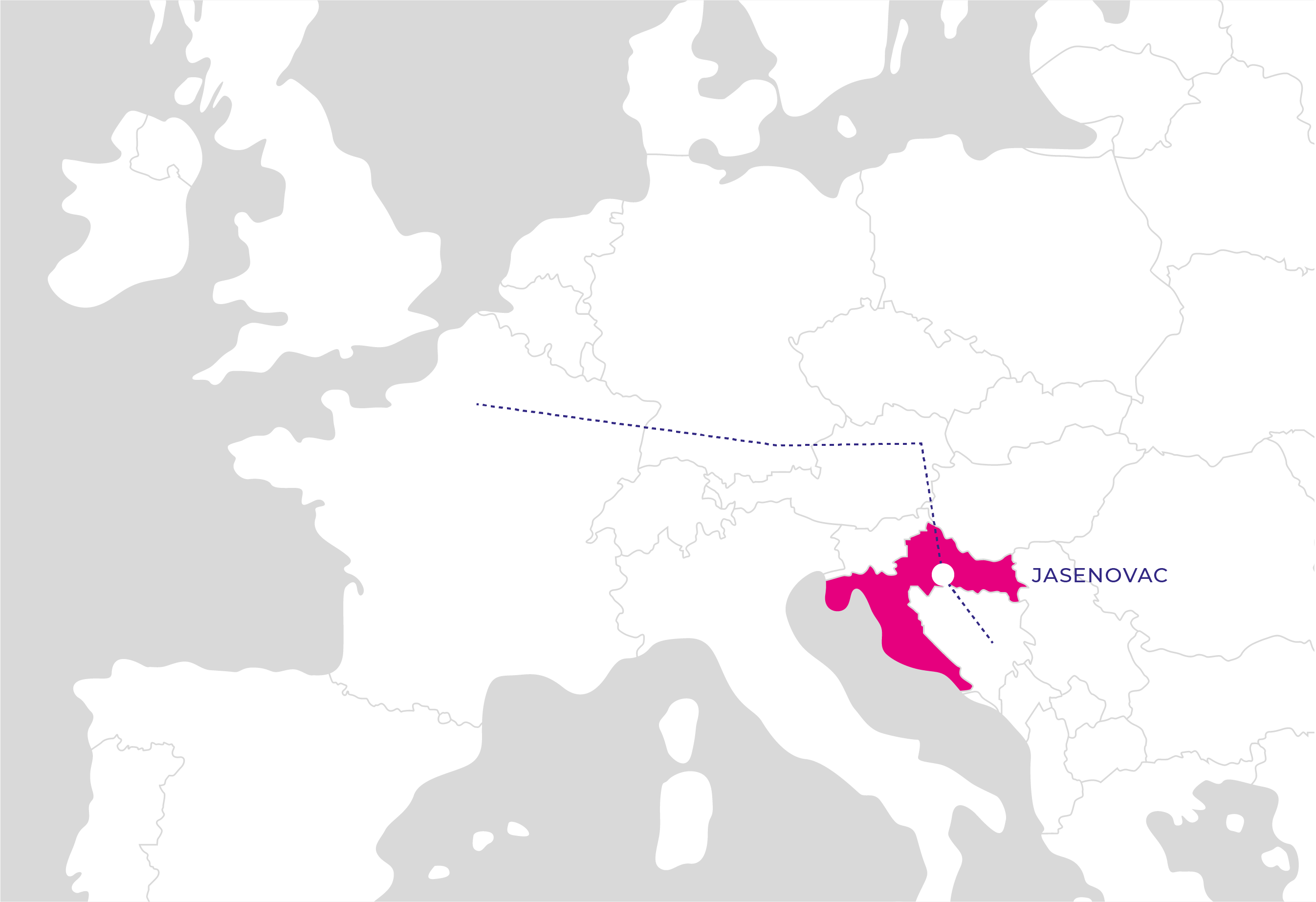
PARIS
MUNICH
VIENNA
SARAJEVO
BERLIN
Jasenovac: from death camp to peace monument – a place of memory and warning
After Vienna, our journey led us to Zagreb in Croatia before reaching Bosnia-Herzegovina, more specifically Sarajevo. Considering the theme of our journey and its timing, it was crucial to visit the Jasenovac Memorial Site, a former Second World War concentration camp. Jasenovac holds a historical significance as one of the sites where the Holocaust was perpetrated, as well as a genocide of Serbs and Roma, and of other crimes against humanity. However, it is not as well-known as other concentration camps.
The journey from Zagreb to Jasenovac, which took less than two hours, revealed a variety of landscapes and changing weather conditions. Upon arrival in Jasenovac, a quiet atmosphere of peace and silence prevailed, echoing the tragic history of this place where the victims of the Holocaust, genocide, and other crimes against humanity are laid to rest. Situated in the county of Sisak-Moslavina, Jasenovac has been heavely impacted by emigration, due to socio-economic challenges resulting from the Balkan Wars in the 1990s. The demographic landscape of the region has shifted, with an older population and a considerable number of young people leaving this area, a change exacerbated by the destructive earthquake 2020. The 2021 census indicates a substantial decrease in Jasenovac‘s population to 525, mainly Croats (93%) and a Serbian minority (around 5%). In summary, historical conflicts and recent natural disasters have compounded the area‘s struggles, contributing to a decline in population numbers.
History of the Jasenovac concentration camp
Guided by Martina Barešić, our group spent an extended period of time outside the museum, immersing themselves in the intricate and tragic history of Jasenovac. Being the largest death camp of the Second World War that was not operated by the Germans but by the Ustaše regime of the Independent State of Croatia (Nezavisna Država Hrvatska, or NDH), it played a crucial role in enforcing racial laws against Jews, Roma, and those perceived as enemies. Established in 1941, it mirrored Nazi camps and became a symbol of persecution. The camp was under the supervision of the Ustaše Ministry of the Internal affairs, led by Andrija Artuković. It was never officially closed, but on April 22nd 1945, a prison break took place, during which most of the prisoners were killed. This escape was a remarkable act of courage. Afterwards, the Ustaše regime tried to cover up crimes by burning the corpses, demolishing the buildings, and destroying documentation.
A list of victims at the Jasenovac Memorial Site was established by comparing and critically examining individual data for each child, man and woman killed in Jasenovac. Names and data have been collected for 83,145 victims so far, which is the number that is mentioned when we talk about camp victims. These were mainly Serbs, Roma, Jews, Croats and Muslims, with both sexes and all age groups represented.
Destruction of traces of the camp’s existence and foundation of the Memorial
In Jasenovac, every trace of the Nazi camp was deliberately erased, with the area remaining empty for several years. The materials from the camp were reportedly reused to rebuild nearby villages. After a 15-year hiatus, an initiative emerged in 1959 from the local association SUBNOR Novska in order to commemorate the site and its history.
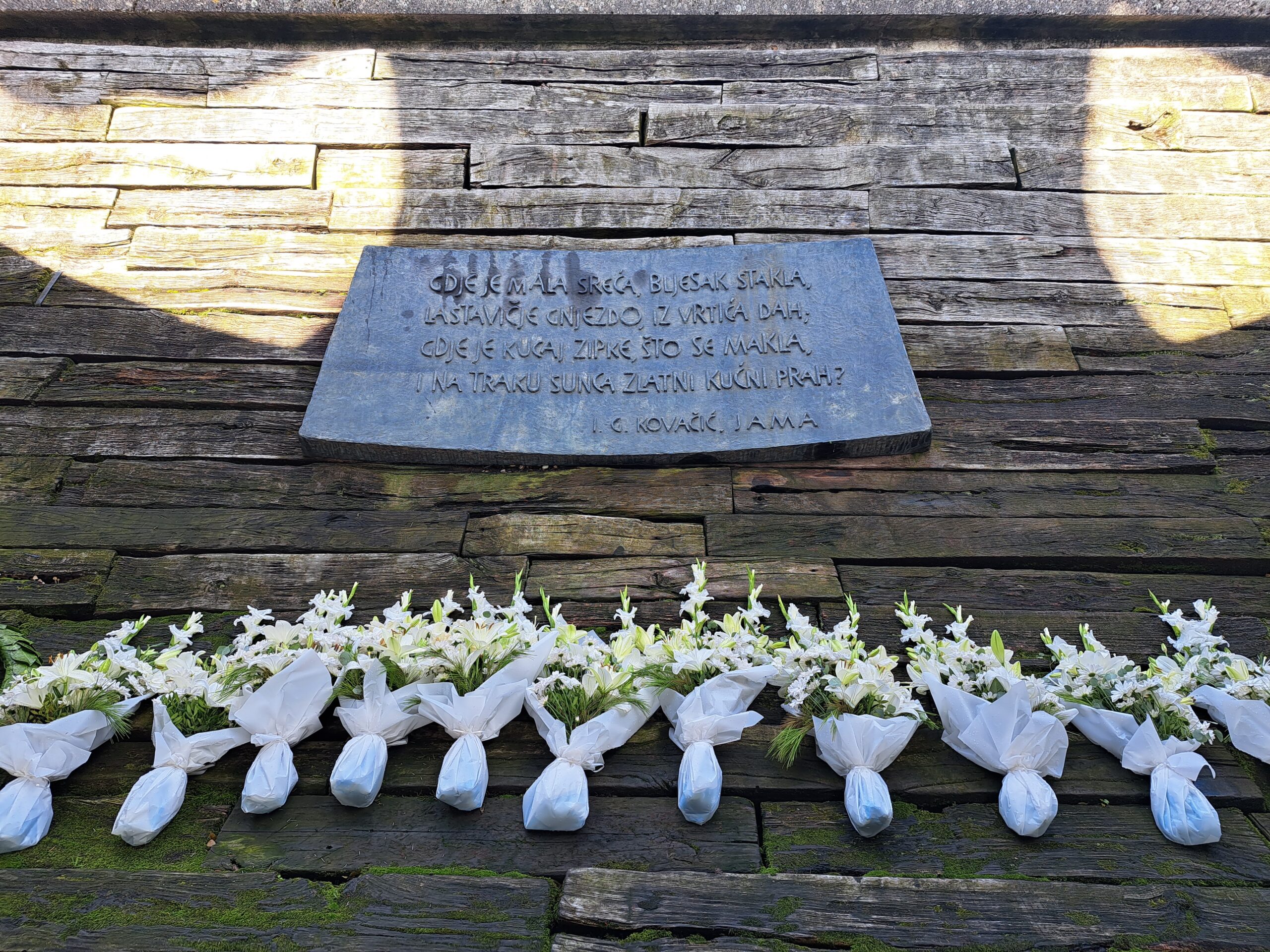
Photo of the Memorial plaque, Jasenovac Memorial Site, Croatia.
The flower as a symbol of life and freedom
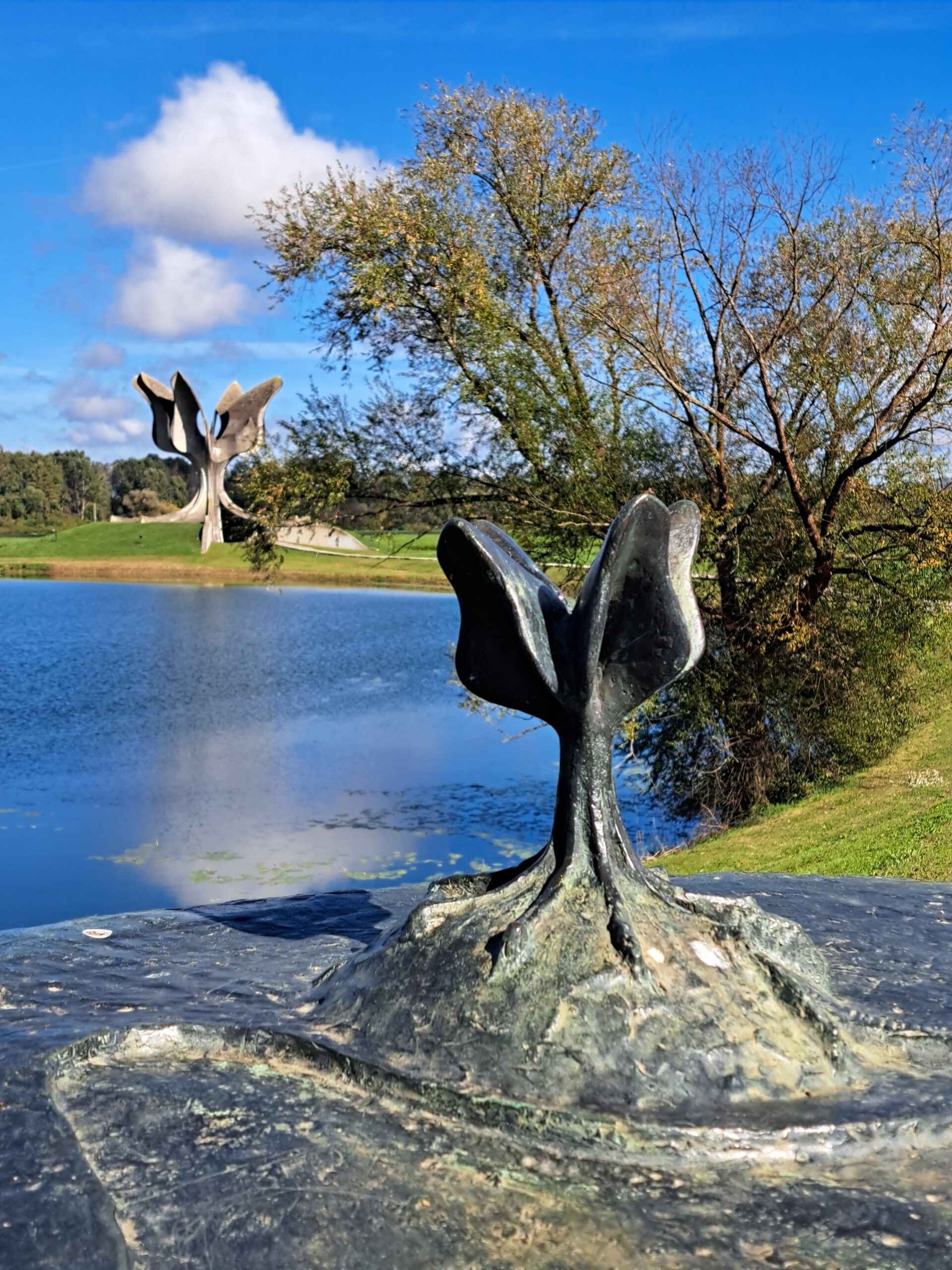
The participants enjoyed discovering this flower monument and its meaning. This is the most striking symbol of the Memorial Site as a „sign of eternal renewal—a structure, as a superstructure, turned dual—a crypt towards the victims from whom it draws its root and a crown, a kind of inverted dome—towards the light and the sun. Symbolically, towards life and freedom“ according to the words of the author Bogdan Bogdanović. He wanted the monument to be a sign of reconciliation and of the end of inherited hatred, rather than a symbol of the horror that took place here. This monument also represents one of the turning points in Yugoslav art, symbolising the acceptance of modernism in sculpture and architecture.
After visiting the external complex of the camp, the group discovered the museum section. We were able to see the museum’s 2006 exhibition, which highlights the names of the victims – they are written on glass plates hanging from the ceiling and on the walls. It is impossible not to see them, impossible to avoid them: they were with us, the visitors, all the time. Curator Martina Barešić, who led the tour, asked the group to imagine, behind the names of the victims, people with families, interests, jobs, hobbies, etc., as it is important to bring the story of Jasenovac closer through those whose names have remained to bear witness to the crime. In addition to the names of the victims, the participants had the opportunity to listen to oral testimonies and see personal belongings of the prisoners, as well as some of tools with which they were tortured and killed.
Currently, according to the words of our curator Martina, the activities of the Jasenovac Memorial Site are developing in several directions—from the collection, research, professional processing, protection and presentation of museum material and documentation on the operation of the Ustashe concentration camp, to education and teaching programmes, exhibitions, publishing, continual cooperation with surviving prisoners, and the organising of commemorations in honour of the Jasenovac victims.
Within just two hours, it was not possible to learn everything about Jasenovac and its history, which was unknown to most participants in the youth exchange. After visiting the memorial, the group was overwhelmed by various emotions and reactions, which we decided to share only the next day. This showed us that Jasenovac, as well as other camps in former Yugoslavia, is an important part of the European culture of remembrance and commemoration, and needs to be talked and learned more about.
Author: Milica Pralica