2. The ideal House
Summary
The group will draw their ideal ”house of communication”. The house is a symbol for the way the participants want to treat each other and communicate. Gradually, in different group sizes, the participants learn about their different expectations and ways of communicating with each other.
Objectives / Goals
- To foster the development of a team spirit
- To enable participants to cooperate by emphasising respect and dialogue
- To show the groups that they need to negotiate and find a way of communicating their wishes while making compromises
Keywords
- Team building
- Mutual cooperation
- Respect
- Dialogue
- Non-verbal communication
Number of participants
20
Type of participants
- Young people and adults
- Age: 10y – 30y
Duration
At least one hour to 1 hour and 30 minutes
Materials / preparation
- One A4 sheet of paper for each participant
- As many different pens in different colours
- A big flipchart paper for the group work
Instructions
Step 1 (10-15 minutes): participants are asked to draw their “ideal house” on one A4 sheet of paper. They can add any feature they want to the house, such as a roof, pool, garden, trees, etc. The team should be careful how they introduce it. For example, they can tell the participants that this is a creative way of learning about communication and cooperation. They might also add that this is a team challenge, since the participants will be working as a team for the whole duration of the youth exchange.
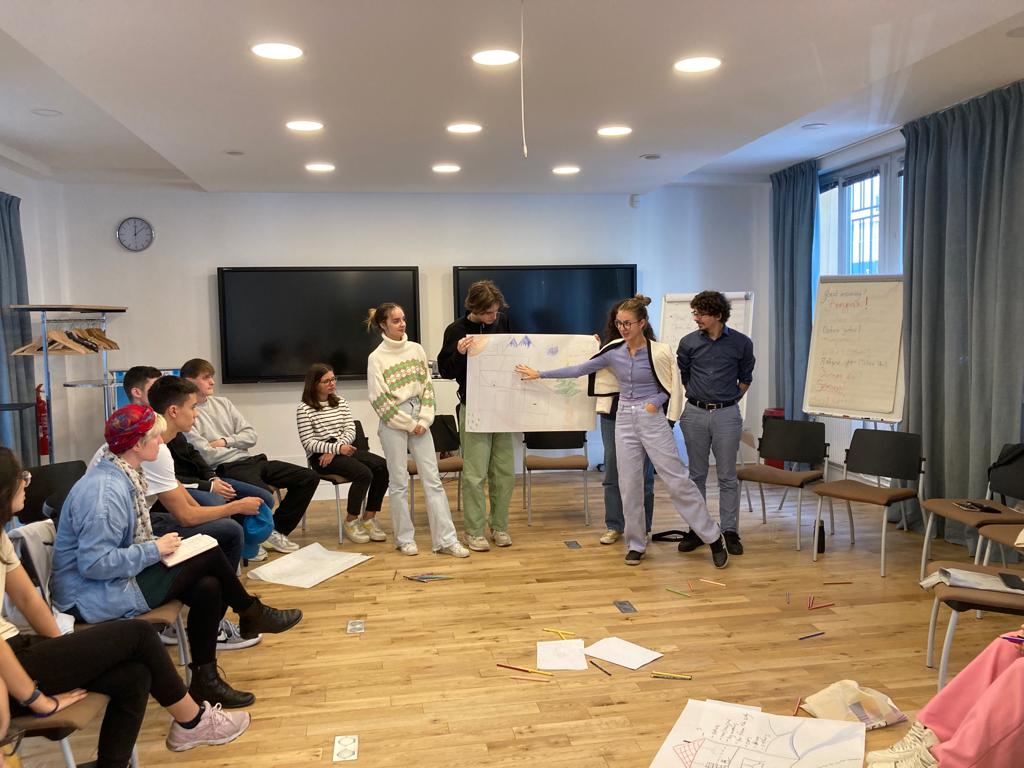
Step 2 (20-25 minutes): after participants have drawn their ideal houses, they are divided into 4 groups who must draw a common house on a flipchart paper, respecting everyone’s wishes.
Step 3 (20-30 minutes): after the small groups have drawn their houses, the whole group of participants is asked to draw one big common house with as many common features as possible. They can decide whether to have one person draw what the group tells them or to alternate between participants, but it is up to them to discuss the procedure beforehand.
Step 4 (10 min): Debriefing – the facilitator asks the groups how they communicated and, if they made compromises, how they reached them.
Recommendations
A large well-lit room with some space to sit down for drawing. To some participants, this activity might seem childish, therefore the team should be careful when they introduce it, for example by pointing out the fact that it is about cooperation and compromise. The facilitators can also present it as a challenge, first for participants individually, then in small teams.
This is a good exercise to follow up on something dynamic, helping to connect on a quieter level and in a creative way. It is a nice way to cooperate and to bond. It can be carried out in the first days of a youth exchange, maybe even on the first day.
Variations
The team can play music if the group is open to it.